Jonathan Haws
 The Prophet Joseph Smith once wrote, in a letter to I. Daniel Rupp on June 5, 1844 (History of the Church, 6:428), that “by proving contraries, truth is made manifest.” He was not suggesting that contradictions cancel each other out — he was suggesting that truth, in its fullness, often requires two things to be simultaneously true. That holding the tension between them is not a failure of reasoning but the very method by which deeper understanding is found.
I want to apply that principle here — to three words from the mouth of Jesus that have stayed with me since we studied them together:
“Remember Lot’s wife.” (Luke 17:32)
Most of us have heard this as a warning. Don’t look back. Don’t long for Sodom. Keep moving forward. That reading is ancient, well-supported, and true.
But I want to propose that it is not the only truth this phrase carries. And that the fuller truth — the one that comes into view when we hold both readings together — may be one of the most important principles of discipleship Jesus ever taught.
The Two Contraries
The first: Remember Lot’s wife as a caution against clinging to what was, against letting your heart remain in a world you’ve been called to leave.
The second: Remember Lot’s wife as an injunction for mercy — as Christ’s invitation to stop, turn, and go back for those who are struggling, those who are frozen, those who are looking backward in grief or fear rather than forward in faith.
Both are true. And as Joseph taught, it is in holding them together that the full truth becomes manifest.
The Traditional Reading: Don’t Look Back
Elder Jeffrey R. Holland, in a devotional address at Brigham Young University on January 13, 2009, gave the classic Latter-day Saint articulation of this teaching. He proposed that what was wrong with the actions of Lot’s wife was not simply the act of looking — it was that in her heart, she wanted to go back. Her attachment to what she was leaving behind outweighed her confidence in where she was going. She looked back longingly. And in that longing, she was frozen.
Elder Holland’s conclusion: “Faith is always pointed toward the future.” Also that “Faith builds on the past but never longs to stay there.”
This reading has echoes in traditions far beyond our own. Buddhism teaches that suffering arises from upadana — clinging. When we grasp at what was, at permanence in an impermanent world, we stop being able to move. Lot’s wife, in this light, is an emblem of the attachment that traps us: not a villain, but a cautionary figure — someone who, at a crucial moment, could not let go.
President Gordon B. Hinckley lived the counter-principle. As a young missionary in England, struggling and discouraged, he received a letter from his father that simply said: “Dear Gordon, I have your recent letter. I have only one suggestion: forget yourself and go to work.” The next morning, he and his companion read: “Whosoever will save his life shall lose it; but whosoever shall lose his life for my sake and the gospel’s, the same shall save it.” (Luke 17:33) The convergence of those two things changed his mission and shaped his entire life. The path forward, he learned, was not self-focused — but it was still forward.
The Reading I Want to Propose
Now read the passage again — but do not stop at verse 32.
“Remember Lot’s wife. Whosoever shall seek to save his life shall lose it; and whosoever shall lose his life shall preserve it.” (Luke 17:32–33)
Jesus places these two sentences side by side. He does not separate them. And I want to suggest that they belong together — that one illuminates the other.
What if the people who need to “remember Lot’s wife” are not primarily those tempted to look back — but those who kept walking? What if Lot and his daughters, marching forward, focused on their own escape and their own survival, are the ones Jesus is addressing? What if the warning is not only don’t be her — but don’t forget her?
“Whoever seeks to save his life will lose it.” A discipleship obsessed with securing your own salvation, your own escape, your own forward progress — that, Christ says, is the path of loss. And the one who lost everything, who turned back, who was left behind in the story — she is the one He says to remember.
The Russian poet Anna Akhmatova, writing in 1924, refused the easy condemnation of Lot’s wife. In her poem “Lot’s Wife” (translated by Richard Wilbur), she asks with quiet devastation who will grieve for this woman — calling her the one who gave up her life for a single glance. Akhmatova refuses to answer that question with a shrug. She sees in this unnamed woman not a failure, but a person of costly, human love.
Akhmatova was herself a woman who had reason to keep walking. During the Stalin era, she could have fled Russia. She did not. She stayed. She gathered witness. She stood with those the escape narrative had forgotten. Her identification with Lot’s wife is not accidental — it is theological. She saw in this woman not a cautionary tale, but a companion.
The 8th-century Buddhist saint Śāntideva gave voice to this same impulse from within his own tradition. His prayer, from the Bodhicaryāvatāra (A Guide to the Bodhisattva’s Way of Life), still chanted in Tibetan Buddhist communities today, expresses the commitment to delay one’s own liberation until all sentient beings are free:
“May I be a guard for those who are protectorless,
Śāntideva — Bodhicaryāvatāra 3:18
A guide for those who journey on the road.
For those who wish to cross the water,
May I be a boat, a raft, a bridge.“
Notice the direction of that prayer. Not upward and forward toward personal enlightenment — but backward and downward, toward those who have not yet made it across. The advanced soul, in Śāntideva’s tradition, turns back. That turning is not a failure of faith. It is its fullest expression.
Here is the synthesis these contraries reveal:
The warning reads: don’t cling to what was, don’t let your heart remain in Sodom, don’t be frozen by longing for the life you’ve been called to leave.
The invitation reads: don’t be so consumed with your own spiritual survival that you abandon those who are frozen, those who are struggling, those who are looking back in grief or in love. The one marching forward, eyes fixed on the horizon, saving their own life — that person is losing it.
Both are true. And both come from the same mouth, in the same breath.
The Cost of Forgetting Her
The German theologian Dietrich Bonhoeffer drew a line that is sharp and useful here. In The Cost of Discipleship (1937), he called it the difference between “cheap grace” and “costly grace.”
Cheap grace, he wrote, is grace without discipleship:
“Cheap grace is the preaching of forgiveness without requiring repentance, baptism without church discipline, Communion without confession, absolution without personal confession. Cheap grace is grace without discipleship, grace without the cross, grace without Jesus Christ, living and incarnate.”
And its costly counterpart:
“Costly grace is costly because it calls us to follow, and it is grace because it calls us to follow Jesus Christ. It is costly because it costs a man his life, and it is grace because it gives a man the only true life.”
A spirituality focused narrowly on securing your own salvation — your own escape, your own ticket forward — is precisely what Bonhoeffer means by cheap grace. You receive the benefit without paying the price of actually following Jesus.
Bonhoeffer himself enacted this theology at its most extreme cost. He was offered safety at Union Theological Seminary in New York — distance from the catastrophe descending on his homeland. He turned back. He returned to Germany, believing he could not help rebuild a country he had not suffered with. That decision eventually cost him his life.
He turned back for those the escape narrative had forgotten. That is costly grace.
The Peruvian theologian Gustavo Gutiérrez, writing in A Theology of Liberation (1971), made the same argument from a different angle. He proposed that to be converted to God is not a movement away from the world — it is a movement toward the neighbor, especially the most vulnerable one:
“A spirituality of liberation will center on a conversion to the neighbor, the oppressed person, the exploited social class, the despised ethnic group. Our conversion to the Lord implies this conversion to the neighbor.”
And then, in a sentence that is almost impossible to move past:
“To make an option for the poor is to make an option for Jesus.”
If we carry that back to the road out of Sodom — where is Jesus? Not leading the column forward. He is with the one left behind. With the one who stopped. With the unnamed woman that history records only as a pillar of salt.
Henri Nouwen, who gave up Harvard and Yale to live among and care for adults with severe disabilities at L’Arche Daybreak, asked a version of Gutiérrez’s question that lands directly on this story:
“Where is God? God is where we are weak, vulnerable, small, and dependent. God is where the poor are, the hungry, the handicapped, the mentally ill, the elderly, the powerless. How can we come to know God when our focus is elsewhere, on success, influence, and power?”
Henri Nouwen, Sabbatical Journey
That question lands with force on Lot’s family walking forward. Where is God? They may have assumed God was with the survivors, the ones successfully escaping. But Nouwen insists: look again. Look at who is behind you.
Sister Chieko Okazaki — the first person of color to serve in an LDS general organization presidency — knew what it felt like to be the figure the escape narrative forgets. A Japanese-American woman who converted from Buddhism into a predominantly white American institution, she spent her entire ministry reaching toward the margins of her own community. In her 1993 book Cat’s Cradle, she wrote directly to those who felt excluded: “If you experience the pain of exclusion at church from someone who is frightened at your difference, please don’t leave… I want you to know that your diversity is a more valuable statement.” She understood that the one who looks back, who can’t keep pace with the column, who sees things differently — is not a failure of discipleship. That is, in its own way, a theology of Lot’s wife. The one who turned. The one who couldn’t keep walking. The one the story forgot. She is not the cautionary tale. She is the point.
The God Who Weeps
And if she is the point, then the question becomes: if Jesus had been on that road with Lot and his family as they fled the burning city, where do you think He would have been standing when Lot’s wife turned?
I believe He would have been next to her. With His arm around her. Weeping.
This is not a sentimental projection. It is a scripturally grounded portrait of who God is.
In Isaiah’s prophecy of the Messiah, written centuries before Bethlehem, we are told that He would be “a man of sorrows, and acquainted with grief” (Isaiah 53:3) — not grief observed from a safe distance, but grief carried. The Messiah would bear our sorrows, not comment on them.
At the tomb of Lazarus, Jesus already knew the resurrection was moments away. He already knew the grief would be swallowed by joy. And when He saw Mary weeping, He did not explain, comfort at a distance, or urge everyone forward. The text simply says: “Jesus wept.” (John 11:35) The witnesses watching said not “see how He mourned” but “See how He loved him.” Weeping with someone, staying with someone in their grief — this is the language of love.
And then there is Moses 7 — a passage unique to the Restoration, and perhaps the most theologically radical portrait of God in all of scripture.
Enoch is shown a vision of the wickedness of the world, and then something that stops him completely: God weeping. He is so astonished that he asks: “How is it that thou canst weep, seeing thou art holy, and from all eternity to all eternity?”
And God’s answer is this: “Behold these thy brethren; they are the workmanship of mine own hands.” He made them. He gave them understanding and agency. They are His children. And He weeps over those who are choosing destruction — not with cold justice, not with detached sovereignty, but with the grief of a parent watching a child choose pain.
The contrast Moses 7 draws is haunting: Satan laughs. God weeps.
Terryl and Fiona Givens built an entire theology on this passage in The God Who Weeps (Deseret Book, 2012). Their core claim is that the God of the Restoration is not the unmoved mover of Greek philosophy — distant, impassible, untouchable by human suffering. He is a God whose heart beats in sympathy with ours. As one reviewer of their book summarized their central thesis, God’s love is “not some kind of abstract untroubled love, but the kind of love which causes God to weep because of the torment humans bring on themselves through sin” — and crucially, God’s vulnerability, His openness to pain, is “the eternal condition of the Divine.” His capacity for grief is not a weakness. It is the very thing that makes Him God.
Fiona Givens, in a conversation with Spencer Fluhman of the Maxwell Institute about her and Terryl’s book, The Christ Who Heals, reflected on the baptismal covenant in terms that bring this full circle. She expressed a wish that the covenants from Mosiah 18 were still spoken aloud at the water’s edge, as they were in the early Church — “because they are so powerful.” For her, to have stood and said aloud, “I covenant with you that I will carry your burdens. I covenant with you that I will mourn with you when you mourn. I covenant with you that I will comfort when you are in need of comfort” — is to discover that all three members of the Godhead are present in that moment: “The God who weeps — Man of Holiness, God the Father. The God who carries our burdens is Christ, carrying our sufferings and being the co-sufferer. And the God who comforts is the Holy Spirit.”
This is the covenant we make at baptism, recorded in Mosiah 18:8–9:
“To bear one another’s burdens, that they may be light; yea, and are willing to mourn with those that mourn; yea, and comfort those that stand in need of comfort.”
The covenant is not to march forward unencumbered. It is to turn back. To stay. To mourn with those who mourn. To stand next to the one who cannot keep walking and say, with your presence: I see you. I am not leaving without you.
Christ standing next to Lot’s wife — arm around her, weeping with her — is not a departure from covenant discipleship.
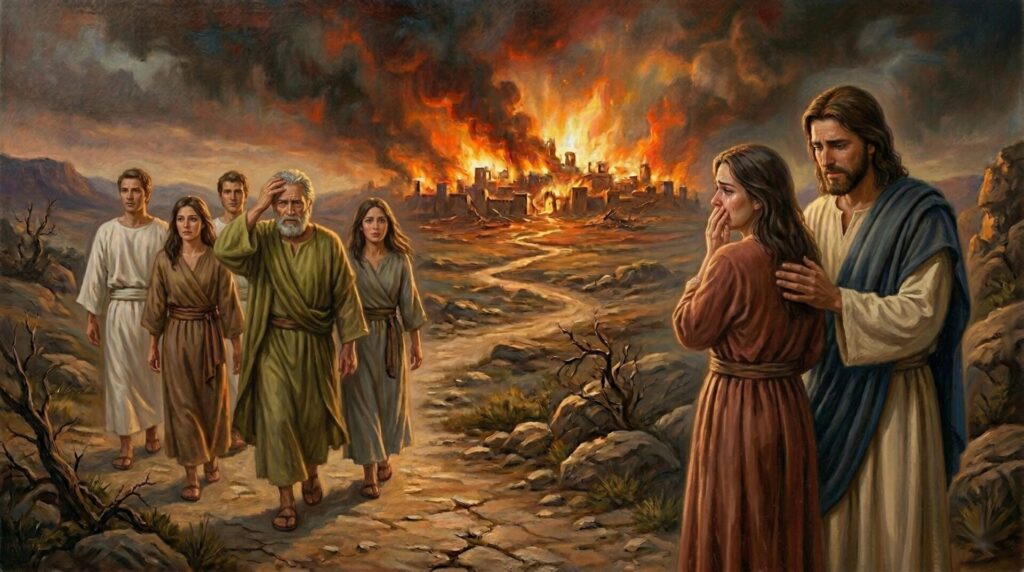
It is covenant discipleship.
So remember Lot’s wife.
Remember her as a caution: faith is pointed forward, not backward. Don’t let your heart remain in the burning city.
And remember her as an injunction: don’t forget those who are looking backward in fear or grief or love. Don’t save your own life at the cost of forgetting theirs. Don’t march forward so focused on your own escape that you leave someone behind.
Both are true. And the God who holds them together — the God of cheap grace and costly grace, of justice and mercy, of forward faith and backward compassion — is not ahead of the column urging everyone forward.
He is back where the suffering is.
Because that is where He has always been.